
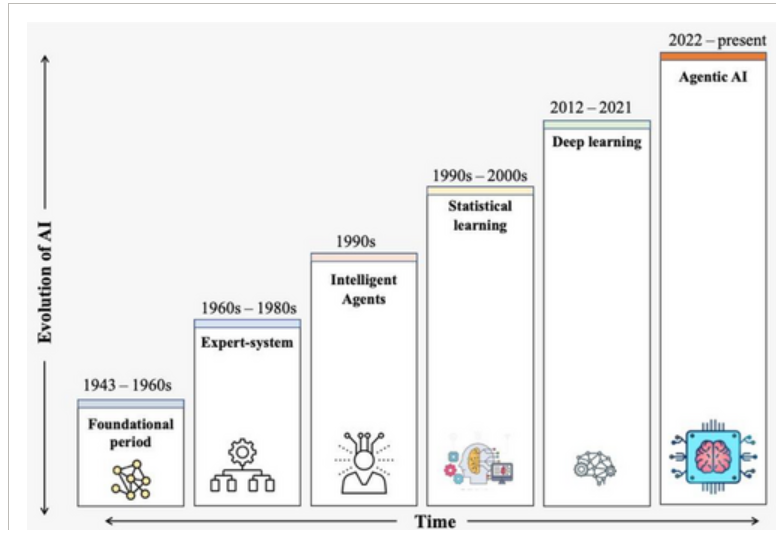
Evolution of AI (image from [1])
In the article “Agentic AI Systems: What It Is and Isn’t [1],” the authors explore the emerging concept of Agentic AI and explain why it represents a new and powerful evolution of artificial intelligence.
They describe agentic AI systems as AI systems capable of autonomously pursuing complex goals over time. Unlike traditional AI tools that simply respond to prompts, agentic systems can plan, act, adapt, and make decisions in a more continuous and goal-driven manner.
At their core, agentic AI systems combine generative AI capabilities with a closed-loop architecture. This means they do not just generate outputs, they plan tasks, store and retrieve memory, use external tools, and continuously adapt based on feedback from their environment. They can decompose high-level objectives into sub-goals, learn from intermediate results, and adjust their strategies in real time.
To illustrate this, the authors provide examples such as a lifelong digital health coach that dynamically adjusts recommendations based on user behavior, or an intelligent travel concierge that not only suggests destinations but also plans, books, monitors changes, and automatically updates itineraries.
However, the authors also emphasize that increased autonomy brings new challenges. As AI systems begin to act more independently, important concerns arise regarding alignment (ensuring the system acts according to human intent), accountability (who is responsible for its decisions), and the risk of unexpected or emergent behaviors. Managing these risks is as critical as advancing the technology itself.
Another key issue highlighted in the article is conceptual confusion. The term “agentic AI” is often used loosely and sometimes conflated with chatbots, generative AI models, or traditional software agents. The authors argue that agentic AI constitutes a distinct category with specific technical and functional characteristics that must be clearly defined. Therefore, the article aims to bring conceptual clarity by:
-
Tracing the historical evolution of AI leading to agentic systems
-
Explaining how agentic AI differs from conventional AI agents and generative models
-
Exploring the opportunities and risks these systems present for businesses and consumers
Reference:
[1]. Dwivedi YK, Helal MY, Elgendy IA, Alahmad R, Walton P, Suh A, Singh V, Jeon I. Agentic AI Systems: What It Is and Isn't. Global Business and Organizational Excellence. 2026 Mar;45(3):253-63.
